

Short Description
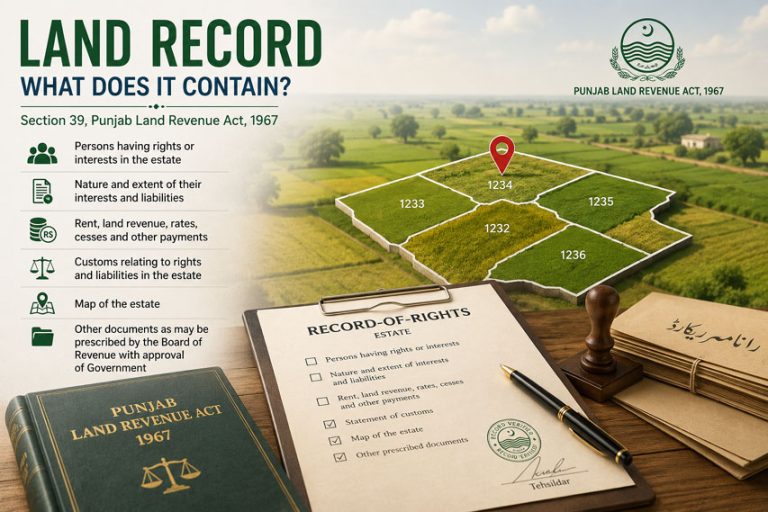
Section 39 of the Punjab Land Revenue Act, 1967 provides for a Record-of-Rights for each estate. The record contains information about landowners, tenants and other persons having rights or interests in the estate, the nature and extent of those interests, related rents and land revenue, customs concerning rights and liabilities, and a map of the estate. The Board of Revenue may also prescribe additional documents with the previous approval of the Government.
Original Law — Section 39, Punjab Land Revenue Act, 1967
39. Records-of-rights and documents included therein.– (1) Save as otherwise provided by this Chapter there shall be a record-of-rights for each estate.
(2) The record-of-rights for an estate shall include the following documents, namely:-
(a) statements showing, so far as may be practicable–
(i) the persons who are land-owners, tenants or who are entitled to receive any of the rents, profits or produce of the estate or to occupy land therein;
(ii) the nature and extent of the interests of those persons, and the conditions and liabilities attaching thereto; and
(iii) the rent, land-revenue, rates, cesses or other payments, due from and to each of those persons and to Government;
(b) a statement of customs respecting rights and liabilities in the estate;
(c) a map of the estate; and
(d) such other documents as the Board of Revenue may, with the previous approval of Government, prescribe.
What Does This Mean?
Section 39 establishes what should be included in the Record-of-Rights of an estate. In simple terms, the land record is intended to provide information about the people who have rights or interests in the land and the nature of those rights.
The record may show the following:
Landowners and tenants:
It identifies, so far as practicable, persons who are landowners or tenants and certain other persons who have rights relating to the land.
Rights and interests:
It records the nature and extent of the interests of those persons, together with the conditions and liabilities attached to those interests.
Rent and land revenue:
It includes information about rent, land revenue, rates, cesses and other payments due from or to the persons concerned and the Government.
Customary rights and liabilities:
The record may contain a statement of customs relating to rights and liabilities in the estate.
Estate map:
A map of the estate forms part of the Record-of-Rights.
Additional documents:
The Board of Revenue may prescribe other documents for inclusion, subject to the previous approval of the Government.
Why Is This Important for Landowners?
Section 39 is important because it shows that a land record is not simply a record of someone’s name. It is intended to contain information concerning ownership, tenancy, other interests, liabilities, payments, customary rights and the identification of the estate through its map.
Therefore, when dealing with land, a person should understand the relevant revenue record and should not rely solely on an informal statement or an old document.
Legal Reference
Punjab Land Revenue Act, 1967
Section 39 — Records-of-rights and documents included therein.
Important: The statutory text reproduced above is the wording of Section 39 of the Punjab Land Revenue Act, 1967. The explanatory portions are an original plain-language explanation prepared for QanoonMarkaz for general legal information and are not intended to replace, amend or supersede the original Act or any applicable law.
For Further Information:
If you require further information, legal guidance, or assistance regarding land records, ownership, revenue matters or related legal issues, you may contact QanoonMarkaz for further assistance.
Source: Punjab Land Revenue Act, 1967.
Leave a Comment